
The Assistance Fund: Where Every Hyperliquid Fee Actually Goes
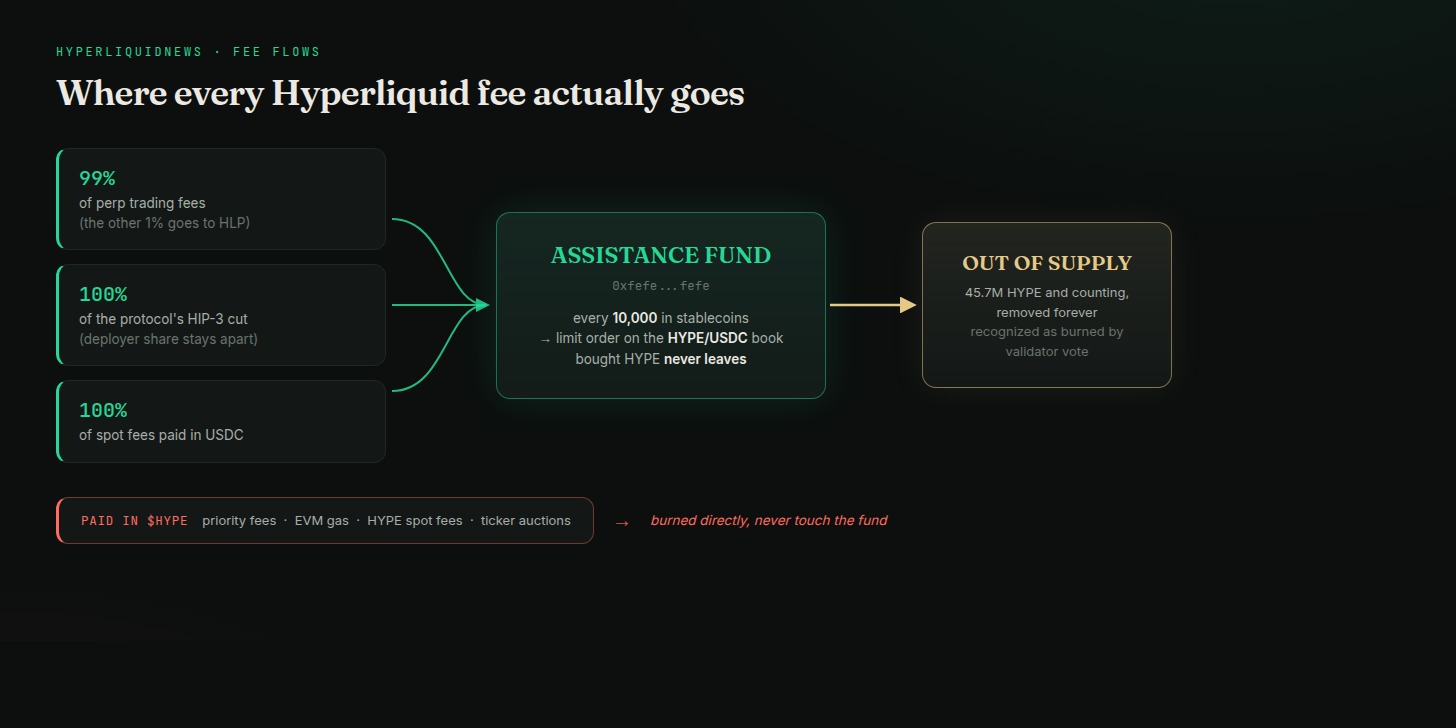
Every exchange collects fees. What makes Hyperliquid unusual is what happens next: no company treasury, no team wallet, no revenue share for insiders. At the center of the machine sits the Assistance Fund, a system address that turns trading activity into permanent buy pressure on HYPE. Let's map exactly what flows in, what doesn't, and what the fund looks like on-chain today.
🏦 1. What the Assistance Fund Is
The Assistance Fund (AF) is not a multisig or a foundation wallet: it is a protocol-level system address, 0xfefe...fefe, operated by the L1 itself. It converts trading fees into HYPE in a fully automated way, directly inside L1 execution. No human signs a transaction, no discretionary policy: the buyback is consensus code.
💵 2. What Flows In
Three pipes feed the fund:
- 99% of perp trading fees. The remaining 1% goes to the Hyperliquidity Provider (HLP), the community liquidity vault.
- 100% of the protocol's share of HIP-3 fees. Builder-deployed markets (TradeXYZ and others) have a separate deployer fee share that belongs to the deployer; everything on the protocol side flows to the AF.
- 100% of spot fees paid in USDC.
A recent illustration of the scale: in late June, TradeXYZ crossed $20M in cumulative revenues, and a matching $20M received by the Assistance Fund had been used to buy back HYPE.
🔥 3. What Never Touches It
The rule is simple: every fee paid in $HYPE is burned directly, it is never sent to 0xfefe...fefe:
- Priority fees: burned at the source. For reference, the best week ever printed $838K of priority fees in 7 days, all destroyed.
- HyperEVM gas: burned, like a classic EIP-1559 base fee.
- Spot fees paid in HYPE: burned directly.
- Ticker auctions, paid in HYPE: those go to yet another address,
0x0000...0000, the null address. (We will cover auctions in a dedicated article.)
Same final destination (supply destruction), different path: the AF buys and holds forever, these streams burn on the spot.
⚙️ 4. How the Buys Actually Happen
No buyback bot, no keeper, no monthly batch announced in a blog post: the conversion is performed by the chain itself while it processes blocks.
- Fees accumulate on
0xfefe...fefe, and only the stablecoins are used for the continuous HYPE buying (not the other tokens). - The execution is mechanical: as soon as a 10,000 threshold is reached in a stablecoin (10,000 USDC, USDE, USDH, USDT...), the fund places a limit order at the current price and waits to get filled. If the price moves away, the order is raised according to the gap between its limit price and the current HYPE price: a patient bid that follows the market without ever chasing it with market orders. The behavior is observable on-chain at any moment: roughly $2M of buying per day at recent volumes.
- The bought HYPE stays on
0xfefe...fefe: it never leaves, and the tokens held by the fund are removed from the circulating and total supply. That burn status was formally recognized by an 85% validator vote in December 2025. - There is a fourth inflow: the reserve yield on Hyperliquid's USDC, paid to the fund in 30-day intervals. Fee revenue scales with volume; this stream scales with TVL.
- The scale so far: about $317M of buybacks in Q3 2025, $255M in Q4 2025, $192M in Q1 2026.
Because the buys are part of consensus execution, they cannot be paused by a team decision or quietly redirected. Changing the flow requires changing the protocol itself.
📊 5. The Fund On-Chain, Today
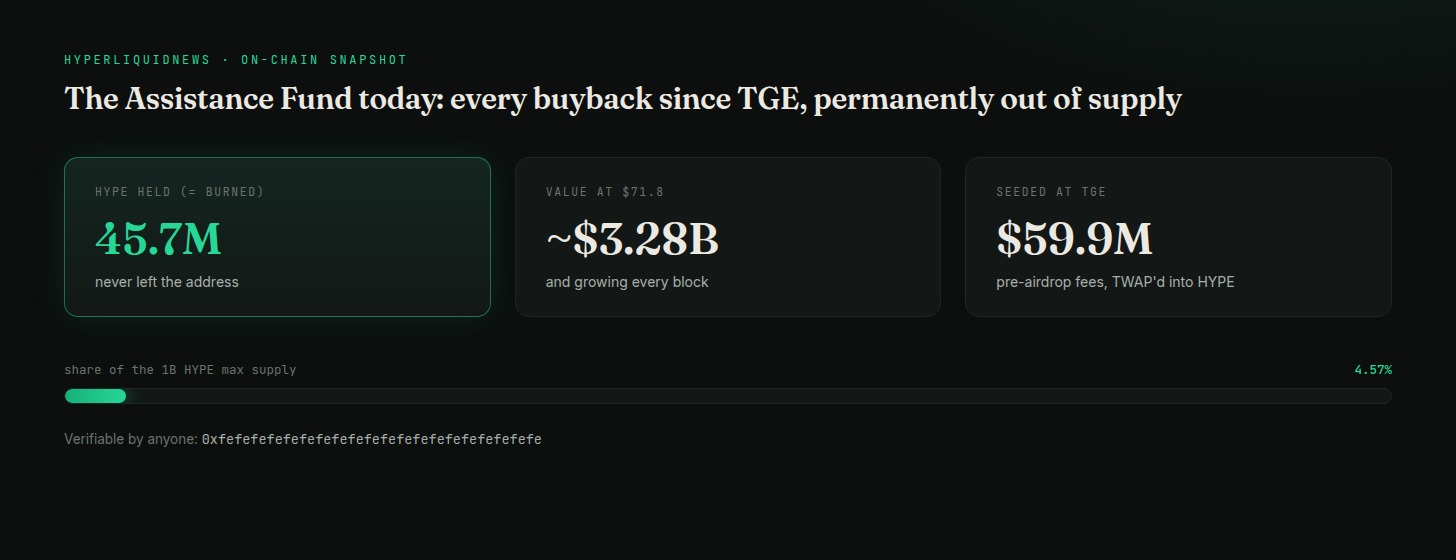
The fund did not start from zero: at TGE, $59,941,526 of fees generated before the airdrop were deposited into it and converted into HYPE via TWAP. The mechanical buying has never stopped since.
Pulling the address balance at the time of writing: 45.7M HYPE, worth roughly $3.28B at $71.8: the cumulative result of every buyback since TGE, permanently out of circulation. The address is public, anyone can verify it.
About the name: "Assistance Fund" dates back to the beginning, when this treasury would have served as a safety net in case of a major incident. Today everything is burned, but everyone kept the name: people know exactly what it refers to.
🎯 6. Why It Matters
The AF reflects the team's ethos better than any speech: the exchange's revenues go back to the token, entirely, automatically. That is what gives HYPE real value: HYPE works like a company with revenues whose holders actually capture the value, at a 99% margin. The bigger the exchange gets, the more buyback and burn there is.
It also matters most in violent markets: on October 10, during the crash, the fund bought more than $20M of HYPE in 24 hours, including more than $16M in a single hour. A mechanical buyer that accelerates exactly when everyone else is selling makes HYPE structurally more resilient.
And the mechanism is built for what comes next: in a bull run, volumes explode; and with HIP-3 markets (stocks, indices, commodities), there is now volume and volatility even outside of crypto. Every new source of volume is a new source of burn.
0xfefe...fefe, receives 99% of perp fees, 100% of USDC spot fees and 100% of the protocol's HIP-3 cut, then converts them into continuous HYPE buys that stay on the address, permanently removed from supply. Everything paid in HYPE (priority fees, EVM gas, HYPE spot fees, auctions) burns directly without passing through the fund. A 99% margin, returned to holders, every block.