
Papertrade: 1000x Leverage With 0 Funding, 0 Slippage, 0 Spread
Most perp exchanges match you against other traders, charge a fee on every trade and make you pay funding. Papertrade does none of that. It is a fully on-chain perpetuals exchange built on Hyperliquid, offering up to 1000× leverage with no orderbook, no spread, no slippage and no funding, and it charges nothing on losing trades. It is also a fair launch: 0 VC, 0 tokens for the team, no pre-mint, no airdrop and no vesting. Every PAPER token is minted by traders. We went through the entire official documentation to explain how it works, what it really costs and where the risks are.
📄 1. What Papertrade Is
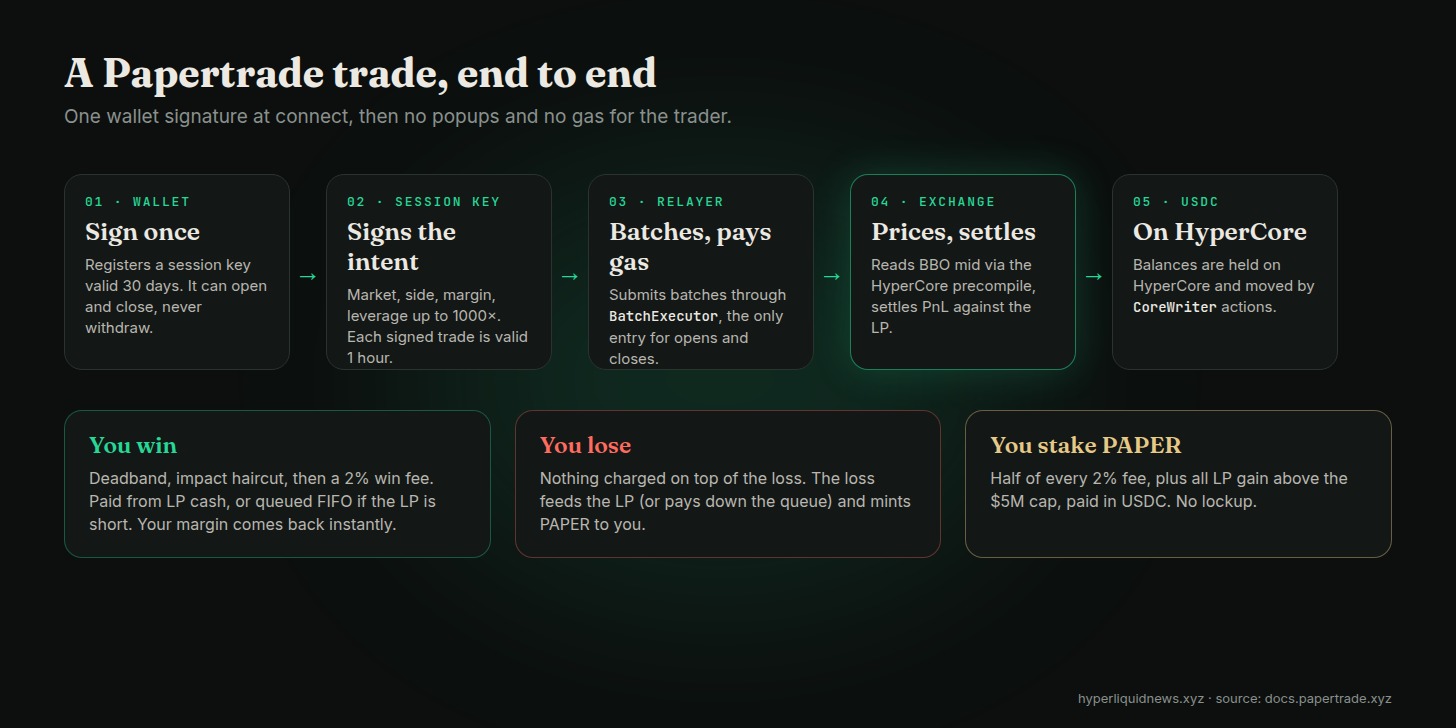
Papertrade is a set of smart contracts on the HyperEVM, Hyperliquid's smart-contract layer. All trading logic lives there, while USDC balances are held on HyperCore, Hyperliquid's native ledger, and moved through CoreWriter precompile actions.
The key design choice: no perpetual contract is ever traded on Hyperliquid itself. Every trade is a synthetic swap between you and the protocol's LP. The contract reads Hyperliquid's best bid and best ask, takes the midpoint, and uses it as your price. The headline features listed in the docs:
- 1000× leverage on BTC and ETH, the two markets available today.
- One-click Buy/Sell, no orderbook.
- Zero slippage, no spread, no funding costs.
- A self-bootstrapping LP that needs no upfront capital.
A single position can reach $10M of notional (margin × leverage). The protocol can list any perpetual that exists on Hyperliquid's order book, including HIP-3 markets; new markets are added by the contract owner. papertrade.xyz is the first canonical frontend.
⚡ 2. How a Trade Works
You pick a market, a direction, a margin and a leverage, then click Buy or Sell. The contract reads Hyperliquid's BBO (best bid and offer) through the precompile at 0x...080e and enters you at the mid:
price = (bid + ask) / 2
That is, in the docs' own words, "the whole pricing stack". No off-chain oracle, no price signer, no oracle committee: the price is the one Hyperliquid's market makers are quoting at that block, read from consensus-verified HyperCore state. Closing works the same way: the contract reads the mid again and settles your PnL against the LP. Because nothing changes hands on Hyperliquid, there is no funding, and you get the mid regardless of size, within per-instrument open interest caps.
The UX is built around session keys. When you connect, your wallet signs once to register a scoped key valid for 30 days. That key signs your opens and closes, so there is no wallet popup per trade, and a relayer batches the signed intents on-chain and pays the gas. A session key can open and close positions on your account, but cannot withdraw, stake, unstake or claim: those always require your real wallet.
Positions are deliberately rigid. Each one is a self-contained "slug" with isolated margin: you cannot add margin, remove margin or change leverage after opening. To scale in, open a second position; to reduce risk, close and reopen smaller.
💸 3. The Only Cost: A Cut of Your Wins
With no notional fee and no spread, the protocol takes its cut in one place only: profitable closes. A winning close goes through three steps:
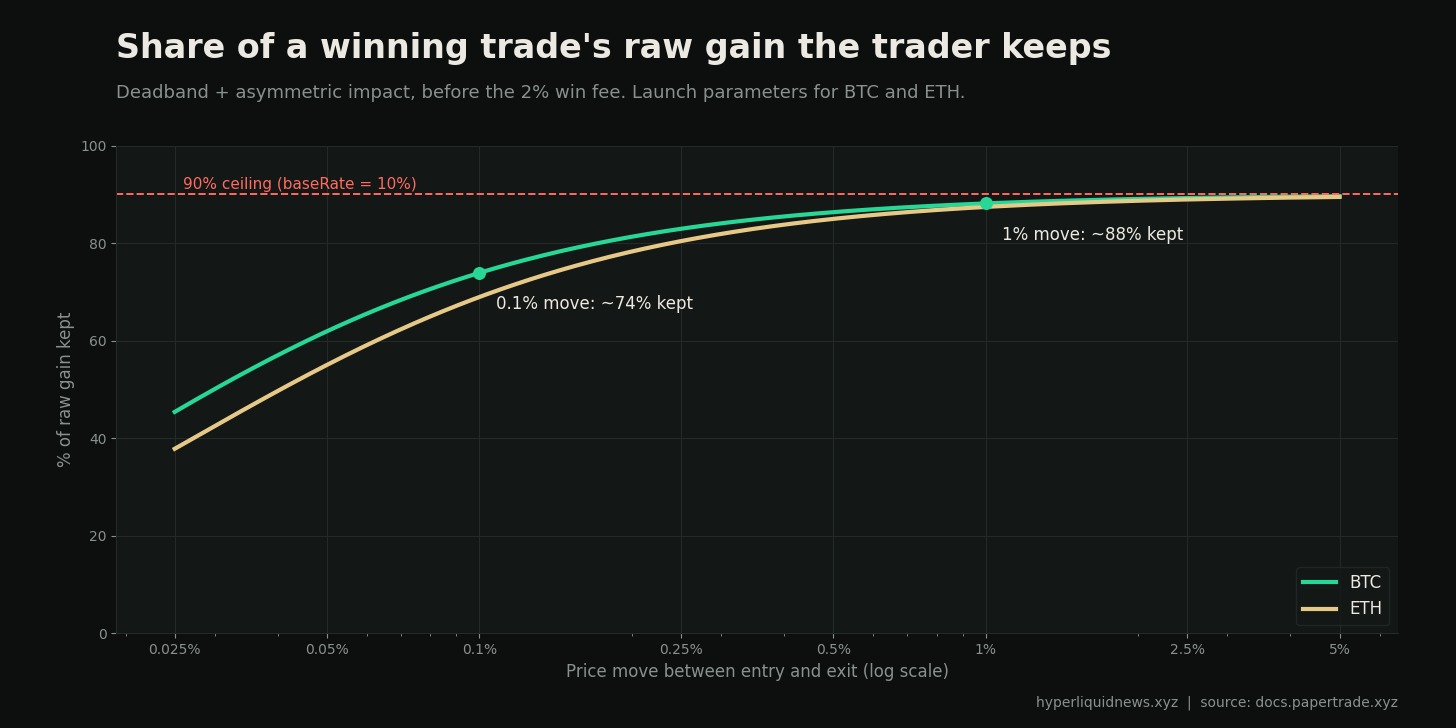
- Deadband: the gain is measured as if the exit were 0.2 bps less favourable. A win smaller than that pays nothing.
- Asymmetric impact: the remaining gain is multiplied by a scale factor that depends on how far price moved between entry and exit, not on your position size.
- Win fee: 2% of what remains.
The impact formula is published in full: scale = (1 − baseRate) / (1 + term1 + term2), where both terms shrink as the move grows. At launch, BTC and ETH both use a baseRate of 10%, so a winner never keeps more than 90% of the raw gain before the win fee. On BTC, the docs give two reference points: a 1% move keeps about 88%, a 0.1% move about 74%. Tiny scalps are taxed the hardest.
The model is adapted from Rollbit's market-impact haircut, with one change: Rollbit's version grows with position size, which at 1000× would push traders toward many tiny positions. Papertrade replaces your size with a fixed per-market reference notional ($100,000 at launch), so the haircut is identical for a $100 close and a $100K close.
Losing trades pay nothing on top of the loss. A 2% fee does exist on losing closes and liquidations, but it is carved from the LP's gain, not added to your loss, and only while the payout queue is empty.
💀 4. Liquidations Are a Hard Bust
Every position shows a bust price. If the BBO mid crosses it, the protocol's keeper liquidates you and you lose the full isolated margin, even if a voluntary close one moment earlier would have returned some equity.
The trigger sits a fixed buffer of about 5 basis points before the zero-equity price. At low leverage that is negligible: at 10×, the threshold moves from 10% to about 9.95%. At high leverage it matters a lot: at 100× the buffer is about 5% of your margin, and at 1000×, liquidation fires after a move of about 0.052%, at a point where a voluntary close would still return nearly half your margin. The liquidation keeper is run by Papertrade and pays a higher priority fee than any other protocol transaction, so liquidations land first.
🏦 5. An LP That Starts at Zero
This is the most unusual part. The LP holds the USDC used to settle trades and starts at $0: no seed capital, no founders' deposit, no LP raise. It grows only from cumulative trader losses, and nobody can deposit into it directly.
The mechanism comes from the Martingaler whitepaper by Martin Galer, built to launch a speculation game with no upfront LP and no cap on bet size. When the LP cannot pay a winner in full, the unpaid profit goes into a FIFO payout queue, a running list of on-chain debts paid from the front as future losses refill the LP. The protocol can be temporarily insolvent by design: net LP equity is allowed to go negative.
- Your margin is never queued: on a close, your original collateral returns to your balance instantly. Only the profit portion of a win can wait.
- While a queue exists, new losses are earmarked to pay it down, and no new winner can be paid ahead of earlier queued ones.
- A keeper calls
harveston new blocks to pay queued winners; the function is permissionless. - Your queued balance is spendable as margin for new positions, but a position opened that way can see its whole surviving claim queued again on close.
The docs are clear about what a queued payout is: "real on-chain debt: not a refund, not a haircut, just a delay".
📜 6. PAPER: Minted Only by Losing Trades
PAPER is the LP's fee-claim token, and its distribution is radical: supply starts at zero, with no pre-mint, no team allocation, no VC allocation, no airdrop and no vesting. The only way a token is ever created is a trader closing at a loss or getting liquidated. There is no other path to LP exposure.
The emission rate is front-loaded. While tracked LP is below $2M, including whenever it is underwater, every $1 of eligible loss mints a flat 100 PAPER. Above that, the rate decays as 100 × (S / (S + H))², with S = $120M and H a high-water mark of LP gain past the threshold. That mark never goes down: after $100M of tail-region gain, the rate is about 30 PAPER per dollar forever, even if the LP is later drained to stakers.
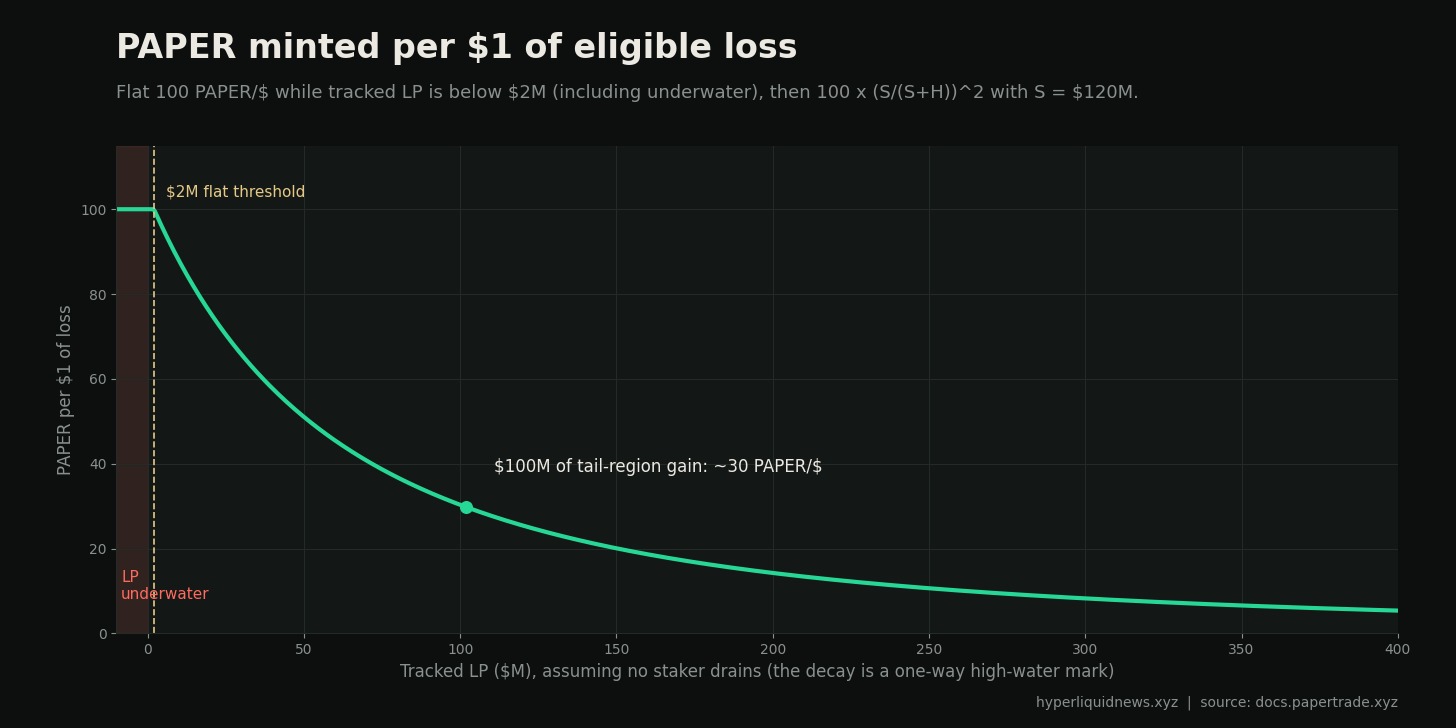
The logic is explicit in the docs: trading while the LP is low or insolvent carries the most variance risk, so it is rewarded the most. Staked PAPER earns USDC from two sources:
- Half of every 2% fee (win fees, plus loss and liquidation fees carved from the LP), the other half going to the dev fee recipient. Fees are paid only while the payout queue is empty.
- The LP surplus: once tracked LP passes a $5M cap, every further dollar of LP gain is distributable to stakers.
Staking and unstaking are instant, with no lockup or cooldown, and there are no boosts or tiers. One important detail: at launch PAPER cannot be transferred between wallets; it can only be minted, staked, unstaked and used to claim.
⚠️ 7. The Risks, as the Docs State Them
The documentation is unusually direct about its weak points:
- BBO manipulation: an attacker can sit a small order inside Hyperliquid's spread to move the mid by a tick or two, and trade Papertrade against the distorted price. The oracle rejects only a zero or crossed book; there is no deviation breaker, no time-weighted price, no lookback. The deadband, the impact curve and per-side OI caps (targeting about $5M of headroom per side) reduce the payoff, but the docs say plainly they "do not prove manipulation unprofitable" and that residual LP-loss risk remains.
- Upgradeable contracts: the contracts are proxied, so "in principle the owner can do anything the implementation can be rewritten to do". The owner also tunes fee and impact parameters and lists markets.
- Pause powers: a pause guardian can permanently retire a market, freezing its price for closes, or halt new opens on every market.
- Relayer dependency: every open and close goes through Papertrade's relayer. Third-party frontends are possible, but they must submit through it. Withdrawals stay user-controlled and need your real wallet signature.
- Session keys: a stolen key cannot withdraw, but it can open and close trades, and so could lose your balance. You can revoke it from your wallet at any time.
🚀 8. Getting Started
- Wallet: any EVM wallet (MetaMask, Rabby, Frame, Rainbow or WalletConnect).
- Deposit: at least 10 USDC from Hyperliquid, HyperEVM, Ethereum, Arbitrum or Solana, or USDG from Robinhood Chain. Each user gets a personal deposit address; transfers from Hyperliquid are credited within seconds. A first deposit pays a one-time 1 USDC activation fee.
- Withdraw: any time, up to your available balance, minimum 10 USDC, to Hyperliquid or on to HyperEVM, Ethereum, Arbitrum or Solana.
Two things are still pending in the docs: the contract addresses on HyperEVM mainnet are listed as "TBA", to be published at launch, and builder codes, a planned 1% revenue share for frontends that bring volume, have no firm date.